
Last updated August 28, 2026
Free in-home measure and quote - PGT, CGI and CWS impact lines compared on your actual openings, style by style






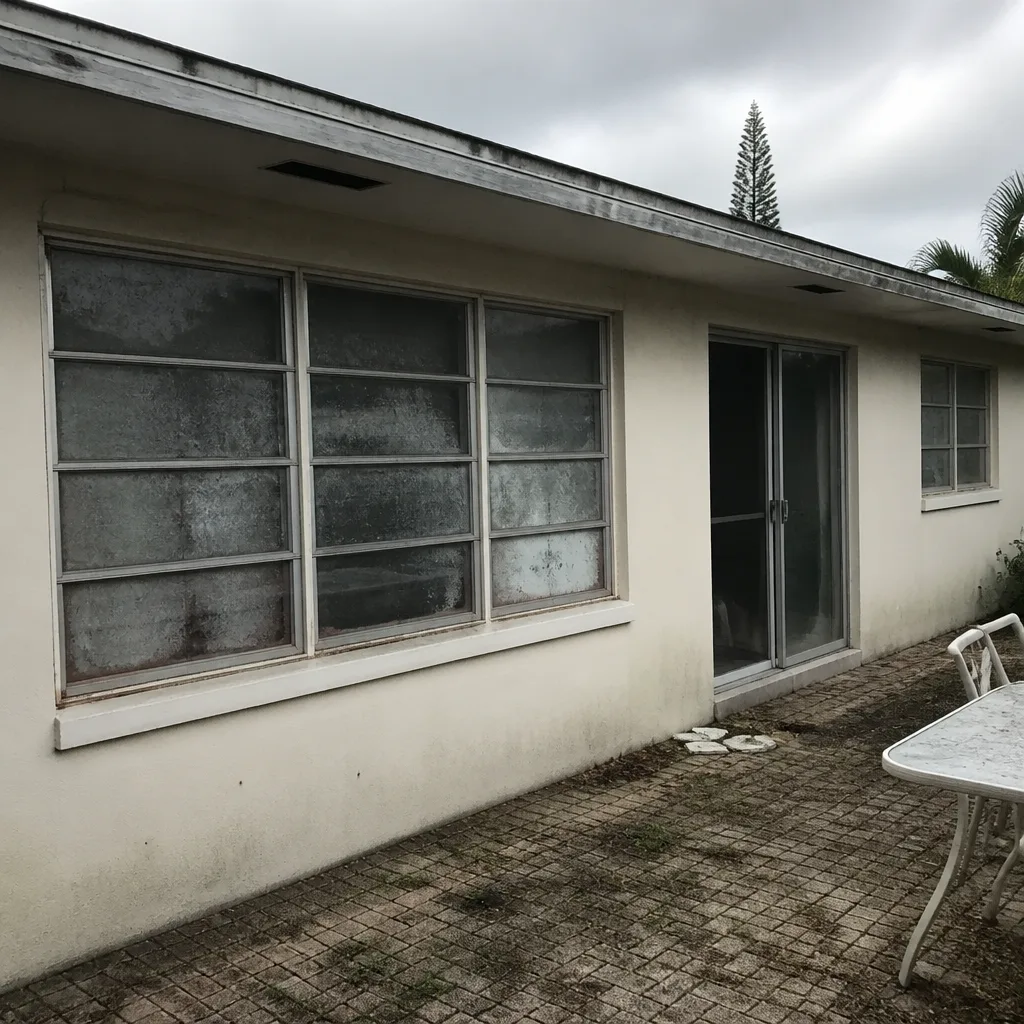 Before
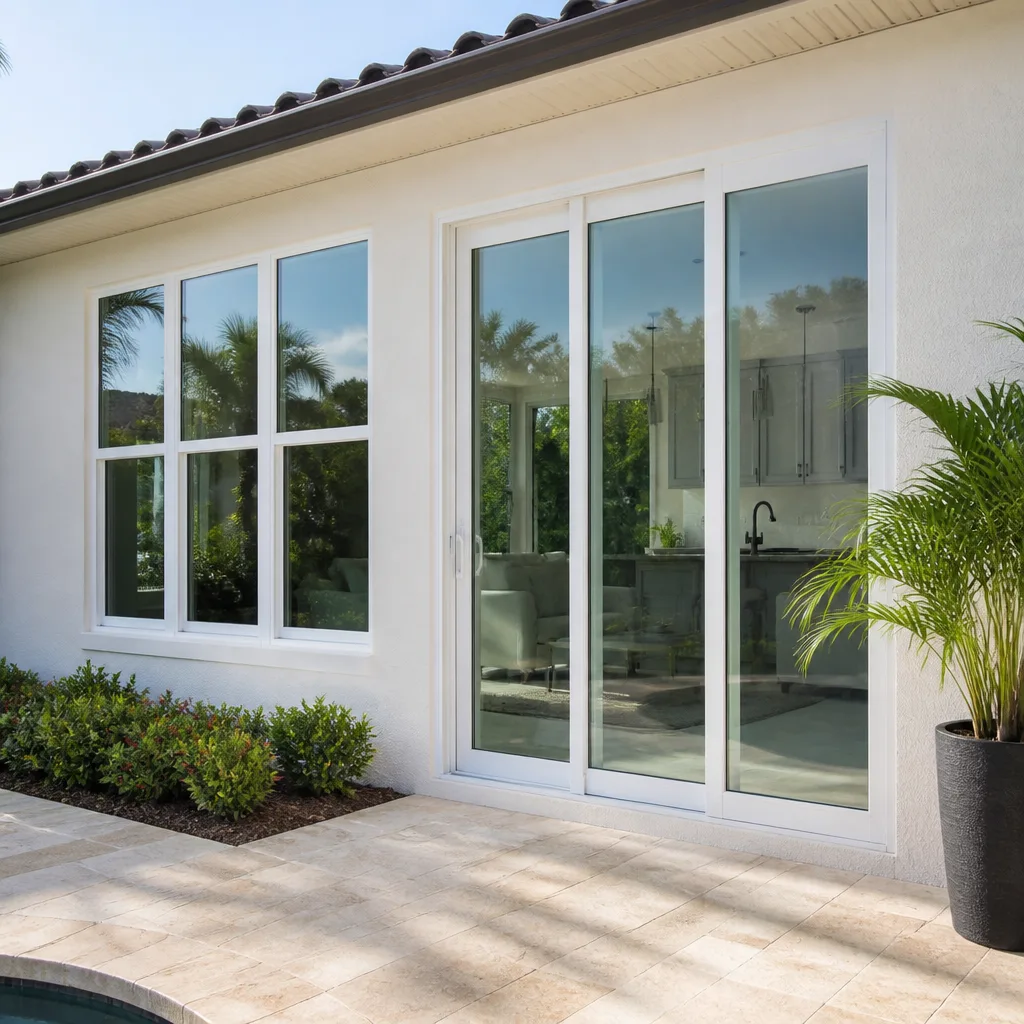 After
After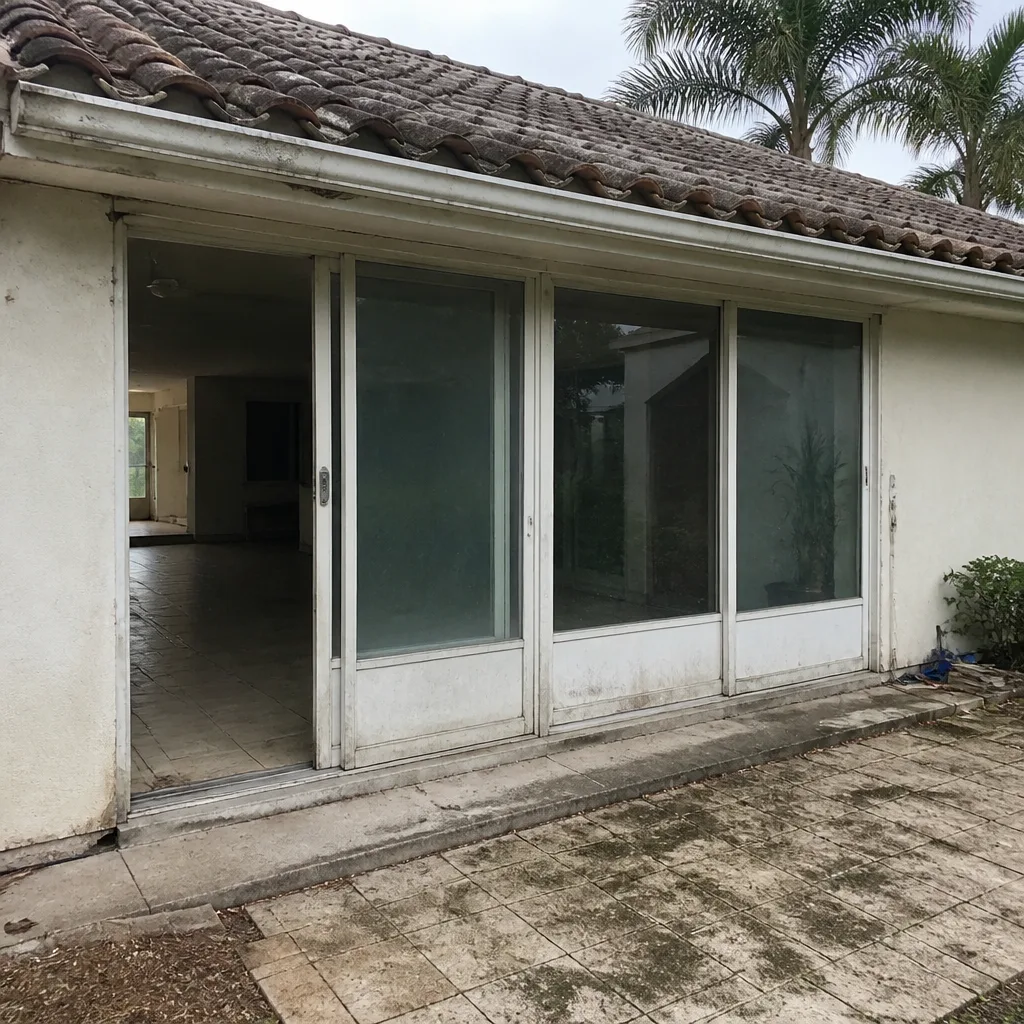 Before
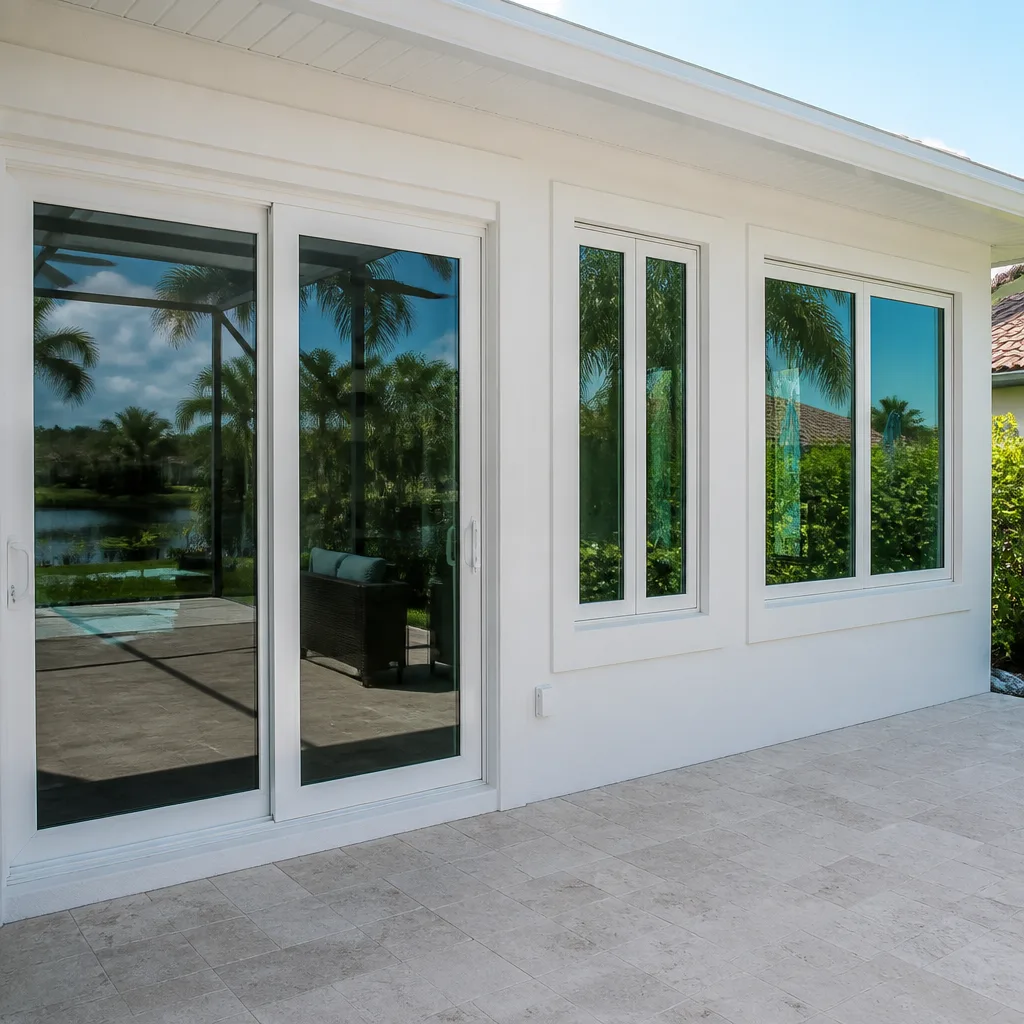 After
After Before
 After
AfterWindows & Doors Warning Signs: A Naples Homeowner’s Reference Guide
A door that swings open on its own isn’t haunted. It’s telling you the frame has shifted, likely from moisture intrusion at the sill, and the latch geometry is now off by enough to matter. In a coastal home in Naples, that shift is also compromising the door’s ability to hold design-pressure loads. That’s not a nuisance; that’s a storm vulnerability. Our Complete Guide to Windows & Doors in Naples teaches you to read the early signals your windows and doors are sending before they turn into emergency replacements at peak-season pricing.
Quick Answer
The most common warning signs that Naples homeowners should watch for are failed IGU seals (persistent haze you can’t wipe off), salt pitting and orange iron staining on frames, sticky sliding doors that require increasing force, water staining or efflorescence at sill corners, and visible daylight around weatherstripping. These problems rarely announce themselves loudly in our climate; they show up as subtle changes in how a window or door feels, sounds, or closes. Catching them early usually means a targeted repair instead of a full replacement, and it protects the design-pressure rating your home needs for hurricane season.
Table of Contents
- Haze vs. Fog: Reading IGU Seal Failure in Naples Humidity
- Frame and Sill Warning Signs Specific to Naples
- Hardware Diagnostics: Testing Multipoint Locks and Roller Wear
- The Candle Test and Other Air-Infiltration Checks You Can Do Today
- Contractor-Created Warning Signs: What Improper Flashing Looks Like from Inside
- Salt, Sand, and Solar: What Naples Climate Does to Glass and Hardware
- Common Mistakes to Avoid
- When to Call a Professional
- Frequently Asked Questions
- The Bottom Line
Haze vs. Fog: Reading IGU Seal Failure in Naples Humidity
Not every cloudy pane is a dead window. In our experience, a lot of Naples homeowners mistake a dirty Low-E coating for a failed seal, and the difference determines whether you’re buying a new unit or just cleaning the glass. Here’s the distinction that matters. A failed IGU (insulated glass unit) seal looks like condensation or a milky film between the two panes of glass. You cannot reach it from either side. It tends to be irregular, forming pockets or patches that move slightly with temperature changes. It gets worse in the morning and may partially clear by afternoon, then returns overnight. That is a failed unit. The argon or krypton gas between the panes has escaped, and outside air with moisture has entered the cavity. You need replacement glass, not a squeegee.
A dirty Low-E coating, by contrast, sits on the room-side surface of the glass (surface #4 in industry terms) or sometimes on the exterior. It cleans off with regular glass cleaner and a microfiber cloth. If you can remove the haze with your fingernail or a damp rag, the seal is fine. Low-E coatings are microscopically thin metal oxides. They can develop a subtle sheen that reads as fog when the sun hits them at certain angles, especially in the low winter light we get in Naples. That’s not failure; that’s physics.
The reason this matters so much in our market: a failed IGU in Naples is often a failed impact window. The same laminated glass unit that carries your design-pressure rating for hurricane loads is the unit that has now lost its insulating gas and taken on moisture. You are not just looking at an energy-efficiency problem. You are looking at a window that is no longer performing to its rated specification. For more on what that means for your home specifically, see our guide to Impact Windows in Naples.
Frame and Sill Warning Signs Specific to Naples
Frames and sills in Naples live a hard life. We routinely see the same three failure patterns across the area, from Old Naples to Golden Gate Estates to Vanderbilt Beach. Learn to read them early, because each one tells you exactly where water is moving.
Efflorescence on concrete block surrounds. That white, chalky powder blooming on the stucco or block below a window sill is not surface mold. It’s mineral deposits left behind when water evaporates from masonry. Efflorescence means water has already traveled through or behind the window’s rough opening, dissolved salts from the concrete, and wicked to the surface. It signals a moisture path that should not exist. Left alone, it gets worse each rainy season. The fix is rarely the window itself; it’s the flashing detail, the sill pan, or the water management system around the rough opening.
Orange iron staining on aluminum frames. This is one we see constantly on aluminum windows installed before roughly 2005. Aluminum doesn’t rust, but the steel fasteners inside older window frames do. When you see a rusty orange drip or streak running from a corner joint or screw head, that fastener is corroding, and it’s corroding because water is reaching it. The stain is the visible symptom of a hidden problem: the frame’s internal weep system may be blocked, or the corner gaskets are failing. In coastal air, this corrosion accelerates. What looks like a cosmetic stain is actually a structural connection degrading inside the frame.
Salt pitting on powder-coated or painted aluminum. If your window frames feel rough, like fine sandpaper, that’s the powder coat failing under years of salt-laden wind. Naples sits in one of the most aggressive atmospheric corrosion zones in the country. Once the coating is compromised, the underlying aluminum begins oxidizing into a white, crustier form of corrosion. At that stage, the frame is losing material, and reglazing or hardware replacement becomes progressively more difficult.
Hardware Diagnostics: Testing Multipoint Locks and Roller Wear
Most Naples homeowners don’t think about their locks until the door won’t lock at all. But a multipoint lock is one of the best early-warning instruments on your exterior door. It will tell you about frame racking weeks or months before the door shows visible misalignment.
- Open the door and throw the lever while watching the top and bottom latch points. They should extend freely, with no grinding, and retract fully when you reverse the lever. Hesitation or a sticky spot in the mechanism means the lock body is binding, often because the frame has racked just enough to pinch it.
- Close the door and engage the lever slowly. You should feel consistent resistance through the full throw. If the resistance spikes in the last 10% of the throw, the door slab is fighting the frame. The lock is telling you the slab is no longer square in the opening.
- Test the deadbolt separately. With the door closed but not latched, try the deadbolt. If it won’t throw cleanly or requires you to pull the door toward you, the strike plate has moved. That movement is almost always a frame shifting away from the jamb.
- Check the keeper alignment on the jamb. Look at the strike or keeper plate on the jamb. You should see a slight, even polish mark where the deadbolt enters. If the wear mark is concentrated at the top or bottom edge of the strike opening, the bolt is dragging. That means the door slab has dropped or risen relative to the frame.
- Listen for the third latch point. Many Florida exterior doors have a top and bottom shoot bolt plus the center deadbolt. When you lift the handle, you should hear three distinct mechanical sounds. If the top bolt is silent, it is not engaging, and your door is holding with two-thirds of its design points.
For sliding doors, roller wear is the equivalent warning signal. Stand inside and close the door. If the door glides silently and stops without a jolt, the rollers are sound. If you hear a sandy grinding or feel the door drop as it rolls, a roller flange has worn flat. A flat roller carves a groove into the bottom track, and in Naples, that groove fills with sand and salt. The door then rubs against the track every time it moves, worsening the wear. We cover what’s involved in correcting these issues in our Window Installation in Naples guide, including the hardware brands we trust.
The Candle Test and Other Air-Infiltration Checks You Can Do Today
You don’t need a blower door to find most air leaks. A candle, a stick of incense, or even a damp hand will do it. The key is knowing where to test, because in Naples, air infiltration follows predictable patterns based on how homes were built and how frames have weathered. Here is a step-by-step inspection you can complete in under an hour.
- Pick a wind day. Wait for one of our steady afternoon sea breezes. A day with 10 to 15 mph winds is ideal. Close every window and door in the house. Turn off ceiling fans and the HVAC system so the interior air is still.
- Start at the corners of each window sash. Light your candle or incense stick and hold it near the lower corners of every window, starting from the inside. Slowly run it along the meeting rail (where the upper and lower sashes meet) and then around the full perimeter. If the flame flickers or the smoke stream bends, you have a leak at that point.
- Test the weatherstripping on exterior doors. Run the candle along the full perimeter of the slab, paying attention to the bottom sweep, the hinge-side jamb, and the top corner where the door meets the threshold. Doors almost always fail first at the threshold corners.
- Check the daylight gaps. On any bright day, stand inside with the door closed and look along the perimeter. If you can see daylight between the slab and the frame anywhere, that gap is letting conditioned air escape. A well-sealed door shows no daylight at all.
- Inspect the caulking line from outside. At every window and door, look at the exterior caulking. On older Naples homes, we regularly see caulking that has pulled away from the frame or the stucco entirely, usually because it was applied over dirt, moisture, or unpainted aluminum. That gap is a direct channel for wet-season rain.
The most common first-fail location in Naples, in our experience, is the lower meeting rail on horizontal sliders. Salt and sand settle in the track, the weatherstrip compresses, and the gap opens precisely at the point where rain blows against the wall. If your slider is more than 12 years old and you can feel even a slight breeze at the middle of the rail, plan on a reseal before peak hurricane season. Our Window Replacement in Naples page covers what a proper reseal versus a full replacement involves.
Contractor-Created Warning Signs: What Improper Flashing Looks Like from Inside
Some warning signs have nothing to do with product quality. They are installed errors, and they show up inside the home in specific, recognizable ways. If you know what you’re seeing, you can address the problem before it becomes a mold or rot issue.
Improper flashing at the head of the window. Flashing is the folded metal or tape that directs water away from the rough opening. When it’s missing or installed backwards, water runs behind the top of the window frame. From inside the home, this looks like water staining at the upper corners of the window trim, or drywall that is slightly soft at the top inside edges. By the time the stain is visible, water has been moving along that path for months. In Naples, a common indicator is persistent musty odor on a window wall after heavy rain.
Missing backer rod before caulking. Joints wider than a quarter inch should be filled with backer rod before sealant is applied. Backer rod is a round foam filler that gives the caulking a proper shape and prevents three-sided adhesion. Without it, caulking pulls away from the joint edges as the building moves from seasonal heating and cooling. From inside, missing backer rod shows up as a window that rattles slightly in strong wind, or air infiltration at the perimeter despite a visible caulk line outside. The caulking looks fine because it stretches, but it is no longer bonded. That is a classic contractor shortcut.
Silicone over old glazing compound. On older wood or hybrid windows, we sometimes find silicone sealant applied directly over decomposed glazing putty. It looks like a fresh, shiny bead around the glass, but underneath, the old putty is crumbling. Within a season, the silicone bead separates from the putty and water channels under it. Inside, you may see paint bubbling at the bottom corners of the sash, or condensation collecting on the interior glass in one corner only. That is water that found a path through a failed seal that was never properly removed and replaced.
We identify these issues on a regular basis when we do free second opinions on written estimates from other companies. If a written quote is vague about flashing method, rough opening prep, or sealant system, that vagueness is itself a warning sign.
Salt, Sand, and Solar: What Naples Climate Does to Glass and Hardware
Naples is not a normal window environment. We live in a high-UV, high-salt, high-moisture, occasionally hurricane-force wind zone. Each of those factors attacks different components on different timetables. Understanding the attack sequence helps you know what to look for as your windows and doors age.
UV exposure is the silent killer of weatherstripping and gaskets. The rubber and EPDM seals around sashes and door slabs lose their elasticity under years of Florida sun. They shrink, crack, and harden. You will notice this as a door that suddenly seems loose in the frame during the winter dry season, when previously it closed firmly. The weatherstripping didn’t fail overnight; it has been degrading incrementally for a decade, and the change became noticeable when drier air made it slightly less pliable.
Salt is what sets Naples apart from inland Florida. Our morning sea mist settles on window hardware and frame corners as a thin saline film. That film accelerates galvanic corrosion wherever dissimilar metals meet, especially where steel screws contact aluminum frames. The orange staining described earlier is a direct signature of salt-mediated fastener corrosion. On exposed metal hardware like roller assemblies and lock levers, we often see a white, crusty oxidation that starts as a cosmetic issue but eventually locks the hardware up entirely.
Heat cycling is the third force. Summer attic temperatures in a Naples home routinely reach 140 degrees. Exterior walls and the frames mounted in them expand and contract every day. Over years, this movement works caulking joints, loosens fasteners, and shifts frames by millimeters. A window that operated perfectly for a decade may start to stick in August, when the frame is at maximum expansion, then operate freely again in January. That seasonal change is your early warning that the frame-to-wall connection is degrading and the window is moving in ways it was not designed to move. You can read more about our approach to quality materials in the Winslow Windows & Doors home guide.
Common Mistakes to Avoid
- Ignoring a sticky lock because the door still opens. A sticky multipoint lock is not an inconvenience. It is the door frame reporting that it has begun to rack. The window of time for a simple hardware adjustment is measured in months, not years.
- Caulking over failed caulking. Layering new sealant over old, cracked sealant is the most common “fix” we see on Naples homes. It traps moisture behind the new bead and accelerates failure. The old bead has to come out first.
- Replacing glass without addressing the source of water. If a window leaks and you only replace the IGU, the new unit will fail on the same timetable as the old one. The water path has to be fixed at the rough opening, not at the glass.
- Assuming all window condensation means a failed seal. Some condensation on the interior surface of the glass in August is normal humidity, not seal failure. The test is whether the moisture is between the panes or on the room-facing surface.
- Waiting until hurricane season to inspect impact windows. Every year, we get calls in May and June from homeowners who have discovered a problem that could have been addressed in February at a relaxed pace. Impact windows should be checked in the dry season, not when a named storm is three days out.
- Ignoring door frame staining because the door still latches. Rust staining at the threshold or lower hinge means water has a path into the frame. The latch may work fine while the interior framing rots. That is a five-figure repair masquerading as a cosmetic issue.
When to Call a Professional
If you see water actively entering around a window or door during rain, call immediately. That is not a wait-and-see situation in Naples, where an afternoon storm can drop two inches of water. If a multipoint lock will not throw, or a sliding door needs both hands and a shoulder to move, the hardware has failed past the point of homeowner adjustment. If you find daylight gaps around an exterior door, especially on the windward side of the house, the weather barrier is compromised. And if you see efflorescence, orange staining, or bubbling drywall at more than one opening, the water issue is not isolated to a single window; it’s systemic. Winslow Windows & Doors offers free estimates in Naples, call (239) 899-6411. Ed Winslow’s name is on the door, and on every job we do.
Frequently Asked Questions
Normal Low-E haze sits on the room-side surface of the glass and wipes off with regular cleaner and a cloth. A failed seal shows as condensation or fog between the two panes that you cannot reach or wipe away. In Naples, we tell homeowners to check on a humid morning: inter-pane fog that shrinks by afternoon and returns overnight is a classic failed IGU. Call (239) 899-6411 for a free inspection if you’re unsure.
Simple repairs like weatherstripping replacement or hardware adjustment usually run $150 to $350. An IGU replacement for a standard impact window often falls between $400 and $900, depending on glass size and rating. Full frame replacement is a different calculation entirely. For an exact number on your specific windows, call (239) 899-6411, and Ed Winslow will give you an honest, line-item quote.
That roughness is the powder coating failing under years of Naples salt air. Once the coating is breached, the aluminum underneath begins oxidizing, creating a white, crusty texture. The corrosion is irreversible and will continue. It is usually smarter to plan for replacement than to chase reglazing on corroded frames. Call (239) 899-6411 for a free evaluation.
Most air leaks around the perimeter of the frame can be fixed with proper sealant removal and re-application, or with new weatherstripping at the sash. If the leak is coming through the frame itself, or the frame is racked, then a full replacement is the honest answer. In Naples, we do free second opinions on written estimates, so you never have to guess. Call (239) 899-6411.
We recommend a full inspection twice a year: once in the dry season, around January or February, and once in early fall after hurricane season. The dry-season check is the important one, because it gives you months of slack time before the next storm season. Call (239) 899-6411 to schedule yours, and remember there is no trip charge inside our home county.
We are authorized installers for PGT, CGI, CWS, and ES Windows, among others. The right brand for your Naples home depends on the exposure, the elevation zone, and the architectural style. We match the product to the house, never the other way around. Call (239) 899-6411 for a free estimate, and Ed Winslow will walk you through the options in plain English.
The Bottom Line
Windows and doors in Naples fail in predictable ways, and the early signals are almost always visible to a homeowner who knows what to look at. Between-pane fog versus cleanable haze, efflorescence versus surface mold, a sticky lock versus a broken one: each distinction tells you whether you are dealing with a repair or a replacement, and how much time you have to act. Learn to read the signs, inspect twice yearly, and keep one trusted local company’s number in your phone. We are the one down the road. Call (239) 899-6411 for a free estimate, and we’ll help you protect the home you’ve built in Naples.
Written by Ed Winslow, Owner at Winslow Windows & Doors, serving Naples since 2011. Browse more guides & resources from our team.
Six Reasons Homeowners Choose Winslow Windows & Doors
Impact systems engineered to design pressures up to +/-100, matched to your wind zone - your openings hold when the storm arrives.
Low-E insulated impact glass from our manufacturer lines commonly cuts monthly cooling bills 20-30%.
Laminated impact glass shuts out up to 40% of outside noise - traffic, neighbors, weather.
Monitoring services run $30-90 a month. Laminated impact glass resists forced entry around the clock, with no subscription.
Florida homeowners average around 25% savings on the windstorm portion of their policy after protecting every opening - some homes qualify for more.
A full impact package upgrades curb appeal, buyer confidence and appraised value in one project.